
Brand governance in email marketing is the system of standards, processes, and controls that ensures every email your organization sends is consistent, compliant, and on-brand — regardless of who built it, which team sent it, or how fast the campaign moved. Without it, consistency depends on human memory. With it, consistency is the default.
Email is the highest-volume, highest-frequency channel most enterprise marketing teams operate. It’s also one of the least governed.
Teams across regions, business units, and functions are all sending campaigns — often from different tools, with different approval processes, and with varying interpretations of what “on-brand” actually means. The result isn’t just inconsistency. It’s risk: legal exposure, deliverability damage, brand erosion, and compliance gaps that compound quietly across every send.
Brand governance in email marketing is how organizations get ahead of that.
What is brand governance in email marketing?
Brand governance in email marketing is the system of standards, processes, and controls that ensures every email your organization sends is consistent, compliant, and aligned to brand — regardless of who builds it or how fast the campaign moves.
It covers three interconnected layers:
Brand standards — the visual and verbal rules that define how your organization presents itself in email. Fonts, colors, logo usage, tone of voice, CTA style, and messaging hierarchy all fall here.
Compliance controls — the legal and regulatory requirements every email must meet. Unsubscribe mechanisms, physical address, consent language, required disclaimers, data privacy requirements, and accessibility standards are all part of this layer.
Operational structure — the workflows, roles, and approval processes that govern how emails move from brief to send. Who can create what. Who reviews what. What requires sign-off before deployment.
Together, these three layers determine whether your email program operates as a governed system or relies on individual judgment at every step.
Why brand governance matters in email marketing
The scale problem
Enterprise marketing teams don’t send one email. They send thousands — across product lines, regions, audiences, and campaign types. At that scale, inconsistency isn’t occasional. It’s structural.
When regional teams adapt messaging outside defined limits, when new marketers copy old campaigns, when agencies build emails without enforced standards — variation accumulates. Colors drift slightly. Disclaimers get reused past their compliance date. Unsubscribe mechanisms move or break. No single email looks wrong. Across a year of campaigns, the brand stops looking like itself.
The compliance problem
Email marketing is one of the most regulated forms of digital communication. CAN-SPAM, CASL, GDPR, CCPA, and accessibility standards like WCAG all impose requirements on what emails must include, how recipients must be handled, and what data can be used for personalization.
Without governance, compliance depends on every marketer knowing every requirement — and applying them correctly under campaign pressure. That’s not a system. It’s a hope.
A single CAN-SPAM violation can cost $43,792 per email. GDPR fines reach €20 million or 4% of global revenue. For regulated industries like financial services and healthcare, the exposure compounds further with industry-specific disclaimer requirements that change frequently and carry real legal liability when applied incorrectly.
The AI problem
AI has made the compliance and brand governance challenge significantly harder. When teams can generate dozens of content variations in minutes, the volume entering the review process increases dramatically — without a corresponding increase in governance capacity.
More drafts mean more surface area for risk. More variation means more opportunities for off-brand language, non-compliant claims, or broken personalization to make it into a campaign. AI accelerates creation. It doesn’t enforce standards.
Brand governance in email is what makes AI-generated content safe to send.
What brand governance looks like in practice
Effective brand governance in email marketing isn’t a style guide or a checklist. It’s a system — one that makes consistent, compliant email the default outcome rather than the result of individual vigilance.
In practice, it looks like this:
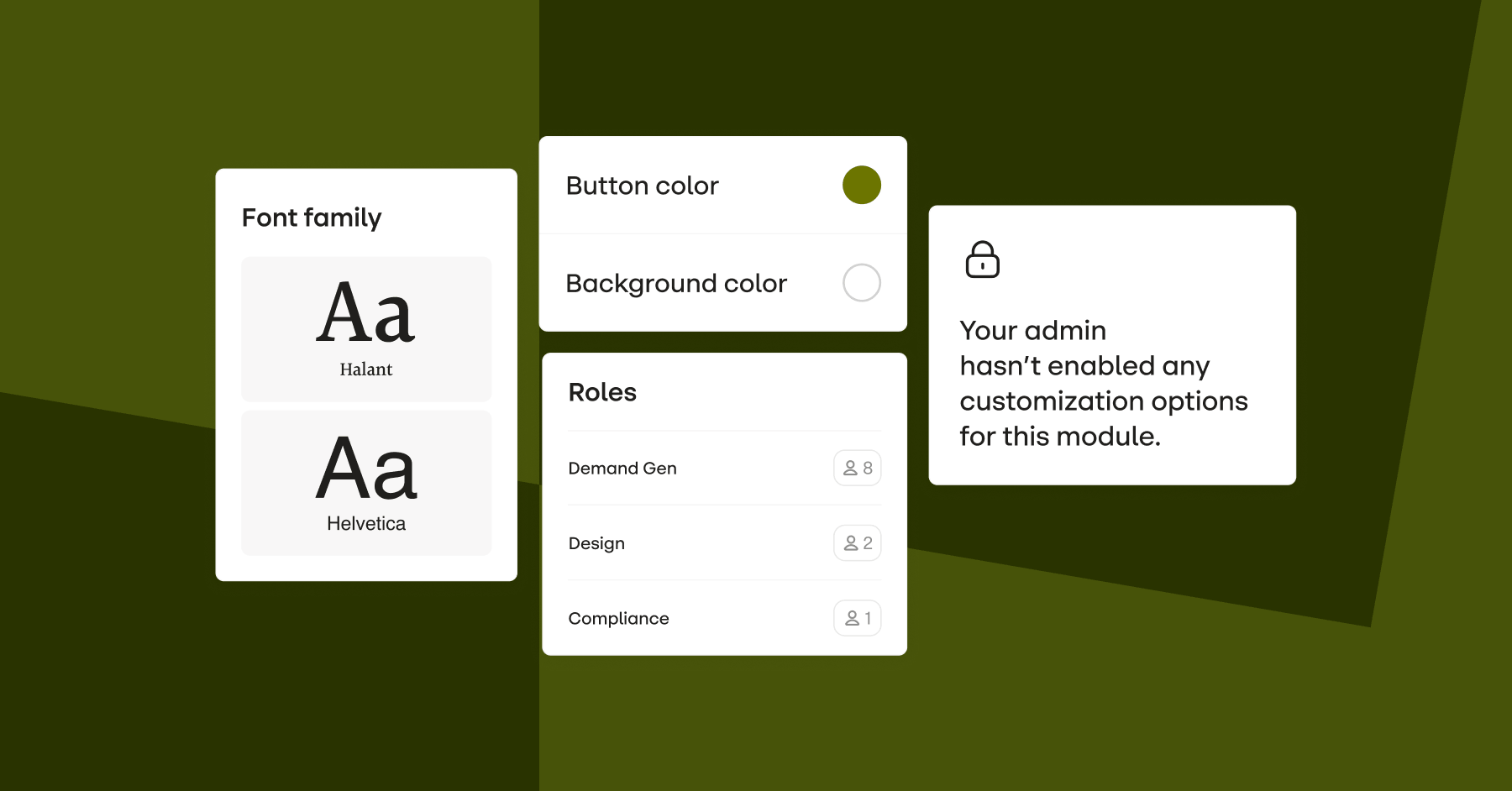
Controlled creation environments — marketers build emails within a system that enforces brand standards by design. Approved fonts, colors, and components are available. Unapproved ones aren’t. Brand consistency isn’t achieved by training. It’s achieved by structure.
Locked compliance modules — required elements like unsubscribe links, physical addresses, legal disclaimers, and consent language are built into the creation process and cannot be removed or moved during editing. Compliance isn’t something marketers remember to include. It’s something they can’t exclude.
Role-based permissions — different teams have different levels of edit access based on what they’re accountable for. A regional marketer can personalize copy within defined parameters. A brand manager can modify approved components. Legal can lock the elements that require their sign-off. The system reflects the organization’s actual risk structure.
Governed approval workflows — review processes are structured and enforced, not ad hoc. The right stakeholders review the right elements at the right stage — before campaigns move to the next step, not after they’ve already shipped.
Audit trails — governance without accountability is just process documentation. Effective brand governance in email includes records of who approved what, when, and under which version of the standards — essential for compliance reporting and regulatory inquiry.
The difference between brand guidelines and brand governance
Brand guidelines tell people what to do. Brand governance makes it structurally difficult to do anything else.
This distinction matters enormously at enterprise scale. Guidelines are essential — they define the standard. But guidelines depend on people reading them, remembering them, and applying them correctly under deadline pressure. At high volume, across multiple teams and markets, that breaks down.
Brand governance moves compliance and consistency from the documentation layer into the creation layer. Standards don’t follow behind the work. They travel with it.
The practical result: what arrives at review is already aligned. Approval cycles get shorter because there’s less to correct. Legal teams spend less time on email review because the risk has been removed upstream. Brand teams stop managing drift reactively because the system prevents it proactively.
Signs your email program needs better brand governance
Most organizations don’t set out to build ungoverned email programs. Governance gaps develop gradually — as teams grow, tools multiply, and the volume of campaigns increases faster than the processes meant to manage them.
These are the signals worth paying attention to:
- Approval cycles are getting longer, not shorter, as email volume increases
- Legal and brand teams are reviewing the same types of issues repeatedly
- Regional or functional teams have developed their own email “versions” of brand standards
- AI tools are in use but there’s no clear governance over what they can generate or how
- Campaign errors — wrong disclaimers, broken unsubscribe links, off-brand design — are surfacing after send rather than before
- New team members take months to learn what’s compliant versus what’s not, because the answer lives in documentation rather than the creation system
Any of these is a sign that compliance and consistency are depending on people rather than process.
The way to keep brand governance on track
Most brand governance programs start the same way: a style guide gets written, an approval process gets documented, a training gets scheduled. And for a while, it works.
Then the team grows. New tools get added. Campaign volume increases. A new agency comes on. AI enters the workflow. And slowly, the gap between what the governance documentation says and what actually ships starts to widen.
The reason isn’t that people stop caring. It’s that governance housed in documentation has to be rediscovered and reapplied every time someone builds a new campaign. At scale, that’s not sustainable.
The organizations maintaining brand governance at enterprise scale have made a structural shift: they’ve moved governance from the documentation layer into the creation layer itself. Standards don’t live in a PDF that marketers reference before they build. They’re embedded in how campaigns get built — enforced by the system, not remembered by the individual.
That’s what Governed Creation™ is built on. When brand standards, compliance requirements, and approval workflows are embedded directly into the creation process, governance doesn’t depend on vigilance. It’s the default. Every campaign — regardless of who builds it, which team sends it, or how fast it moves — starts from a position of alignment.
Brand governance doesn’t break down because people aren’t trying. It breaks down when the system makes it too easy to drift. The fix is upstream.
FAQ
What is brand governance in email marketing? Brand governance in email marketing is the system of standards, processes, and controls that ensures every email an organization sends is consistent, compliant, and on-brand — regardless of who created it, which team sent it, or how many campaigns are running simultaneously.
Why is brand governance important for email marketing? At enterprise scale, consistency and compliance can’t rely on individual judgment. Brand governance creates the structure that makes on-brand, legally compliant email the default outcome — rather than the result of every marketer applying guidelines correctly under deadline pressure.
What’s the difference between brand guidelines and brand governance? Brand guidelines define the standard. Brand governance makes it structurally difficult to deviate from it. Guidelines require people to read, remember, and apply them correctly. Governance embeds standards into the creation process itself, so compliance travels with the work.
How does AI affect brand governance in email marketing? AI increases content volume significantly, which increases the surface area for brand and compliance risk. Without governance, AI-generated content requires the same review burden as manually created content — just at higher volume. With governance embedded in creation, AI output is already aligned to standards before it reaches review.
What is Governed Creation™ and how does it relate to brand governance? Governed Creation™ is the practice of embedding brand, legal, and compliance standards directly into the creation process — so that governance travels with every campaign from the start rather than being applied after the fact. For email specifically, it means brand standards, compliance requirements, and approval workflows are enforced by the system, not remembered by the marketer. It’s the operational model that makes brand governance sustainable at scale.
How do you maintain brand governance as your email program grows? The teams maintaining governance at scale have moved it from documentation into the creation layer itself. Rather than relying on guidelines that marketers reference before they build, they use systems where standards are enforced during creation — through controlled environments, locked compliance modules, and governed approval workflows. Governed Creation™ is the framework that makes this operational.
What does email brand governance look like in practice? It includes controlled creation environments, locked compliance modules, role-based editing permissions, governed approval workflows, and audit trails — all structured so that brand standards and legal requirements are enforced by the system, not remembered by the marketer.