
Healthcare email marketing operates under HIPAA, CAN-SPAM, and a growing stack of state-level privacy laws. The teams doing it well aren’t slowing down to stay compliant — they’ve built governance into how they create, so speed and compliance reinforce each other instead of competing.
Healthcare email marketing is not like other email marketing. The channel is the same. The goal — reach the right person with the right message — is the same. What’s different is the regulatory environment surrounding every send, and the organizational complexity of getting it right at scale.
For enterprise marketing teams in health systems, payers, pharma, and healthtech, that complexity is the daily reality. HIPAA governs how patient data gets used. CAN-SPAM governs how commercial emails get identified and managed. State-level laws like the Texas Responsible AI Governance Act are adding new layers on top of both. And the cost of getting any of it wrong is not abstract.
The good news: compliance and speed are not opposites. The enterprise healthcare marketing teams operating at the highest level have stopped treating them that way.
What sets healthcare email marketing apart
Most enterprise email marketing deals with brand governance, approval workflows, and ESP integration. Healthcare teams deal with all of that — plus a regulatory layer that can turn a single non-compliant send into a six-figure fine and a federal audit.
The core distinction is protected health information (PHI) — any information that could identify a patient and connect them to their health status, care, or payment history. The moment your email marketing touches PHI, through targeting, segmentation, tracking, or personalization, a different set of rules applies.
A healthcare marketer cannot always treat their email list the way a retail marketer would. Segmentation based on conditions or treatment history, pixel-based tracking that captures health data, and automated journeys triggered by clinical events all require additional authorization and controls. That’s before accounting for the BAA requirements that apply to every vendor in your martech stack that handles patient data.
What HIPAA actually requires for email marketing
HIPAA’s marketing rules are specific — and the specificity is useful. Here’s what they require in practice.
Written authorization for PHI-based marketing. If a marketing communication uses PHI to target or personalize, you need the patient’s written authorization first. General promotional emails that don’t use PHI — newsletters, event announcements, educational content — don’t trigger this requirement. The line matters, and it’s worth knowing exactly where it sits.
Business Associate Agreements with every relevant vendor. Every marketing technology vendor that handles PHI — email service providers, marketing automation platforms, CDPs, analytics tools — needs a signed BAA before you activate them. This applies to your ESP, your CDP, your personalization engine, and any AI tools that touch patient data.
Consent propagation that actually works. When a patient opts out, that preference has to flow to every system in your stack — and quickly. Days-long lag times in preference management are a compliance liability that manual processes cannot reliably prevent at scale.
Audit trails. Who approved this email? When was consent captured? Which version was sent to which segment? Regulated organizations need answers to these questions on demand. Workflows that reconstruct approval history from email chains and shared folders create gaps that are expensive to explain during an audit.
The real cost of non-compliance
HIPAA civil penalties range from $100 to $50,000 per violation depending on culpability, with annual caps up to $1.9 million per violation category. Those numbers are real. But the less-discussed cost is operational.
When a compliance team catches an issue after a send, the review burden expands across every campaign that follows. Future sends move slower. Legal stays in the loop longer. Approval processes get more conservative. The short-term cost of one non-compliant email is the fine. The long-term cost is the friction it adds to every send that comes after.
Teams that front-load governance — building review checkpoints, role-based permissions, and template guardrails into the creation process itself — spend significantly less time in reactive compliance mode. The workflow does the governance work so reviewers aren’t catching everything manually at the end.
How to build a compliant healthcare email marketing workflow
Start with governed templates
The fastest path to consistent compliance is governed templates: email frameworks where compliant elements are locked and customizable elements are clearly defined. Required disclaimer language, opt-out mechanisms, and regulated content zones get built in once — by the team with the expertise to get them right — and enforced automatically every time someone creates a new email.
This is meaningfully different from a template library people can freely edit. Governed templates have structure that holds. The non-compliant path is designed out, not just discouraged.
Build approval routing into the workflow, not on top of it
Most enterprise marketing teams have approval processes. In healthcare, those processes need to be structured workflow steps, not informal asks. Compliance review, legal sign-off, and brand checks happen before send — routed automatically based on content type, audience segment, and regulatory category.
The teams that do this well don’t chase approvers. The platform routes the right email to the right reviewer based on rules, and the audit trail is captured automatically.
Separate clinical and marketing systems
Practical advice that eliminates most compliance gray area: keep patient communications and marketing communications clearly separated. Clinical communications — appointment reminders, care instructions, billing notices — live in your EHR or patient portal. Marketing communications live in your email marketing platform.
This separation makes audit trails cleaner, consent management simpler, and BAA requirements more straightforward. It also makes it far easier to answer the “does this email touch PHI?” question before it becomes a problem.
Log everything
If you cannot answer — within minutes — who approved a campaign, when, and which version they approved, your workflow has a gap. Modern email creation platforms capture this automatically. Every draft, revision, and approval is logged. If your current process relies on email threads and shared documents to reconstruct that history, that’s the first thing worth fixing.
AI in healthcare email marketing: where the governance stakes get higher
Generative AI is accelerating email production across every industry. Healthcare is no exception — and the compliance stakes make the governance question more urgent, not less.
AI can generate email copy faster than any human team. Without guardrails, it can also produce content that subtly violates HIPAA marketing rules, and move that content quickly through an under-governed workflow to patients at scale. The risk isn’t always something obviously wrong. It’s something plausibly compliant that isn’t, reaching the wrong audience because no governed review step caught it.
The answer is not to avoid AI. It’s to ensure AI generates within governed templates, brand rules, and compliance parameters from the first draft. When guardrails are built into the creation environment — not checked after the fact — AI becomes a safe accelerant rather than a new liability.
This is the principle behind Governed Creation™: governance embedded into the creation process itself, so speed and compliance aren’t in tension. They reinforce each other.
What healthcare marketing teams doing this well have in common
The enterprise healthcare marketing teams operating at their best share a few patterns. They’ve separated promotional and clinical communication systems, with clear ownership of each. They use governed templates where compliant elements are locked. Their approval workflows are built into the creation platform — not bolted on at the end. They have BAAs in place with every vendor that touches patient data. And they treat consent propagation as a technical infrastructure requirement, not an operations task.
The result is a team that moves at the speed the business requires without operating in a state of permanent compliance anxiety. Governance is not slowing them down. It is what makes their speed sustainable.
How Stensul supports healthcare email marketing compliance
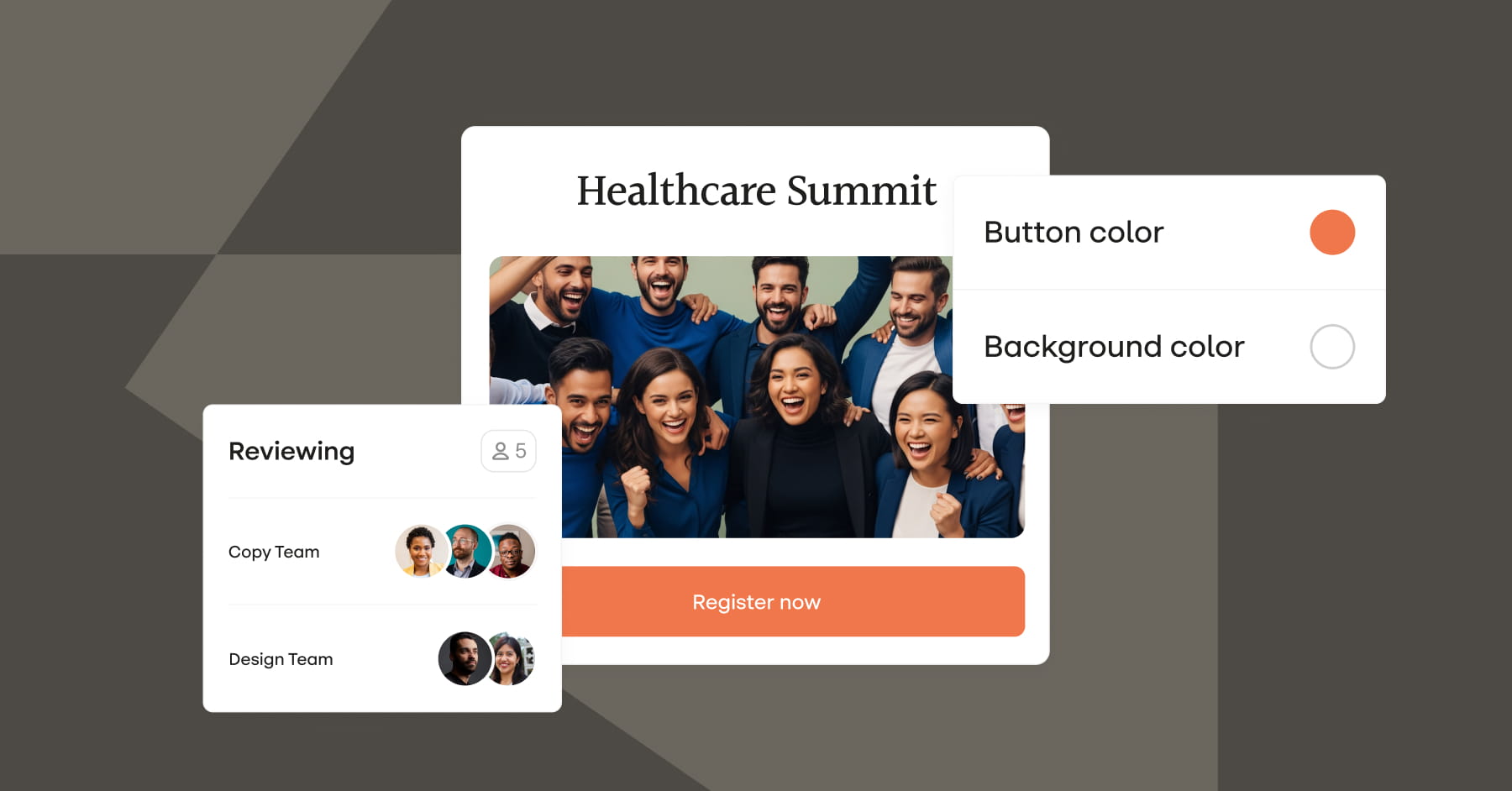
Stensul’s Governed Creation™ Platform is built for exactly the kind of regulated, high-stakes marketing environment that healthcare teams operate in. Governance is embedded directly into the creation process — not reviewed at the end of it.
In practice, that means governed templates with locked compliance elements, structured approval routing that automatically engages the right reviewers based on content type and audience, and comprehensive audit trail logging that documents every draft, revision, and sign-off. When an AI tool generates email content inside Stensul, it generates within those same governed parameters — so the speed AI creates doesn’t outpace the compliance controls the organization requires.
Enterprise healthcare marketing teams using Stensul reduce campaign creation time by up to 90% — not by cutting corners on compliance, but by eliminating the manual rework and bottlenecks that slow production when governance is an afterthought. Organizations like BlackRock, Equifax, and Thomson Reuters trust Stensul to govern their email creation at scale. For healthcare teams navigating HIPAA, BAA requirements, and the growing complexity of state-level privacy laws, it’s the same principle applied to a higher-stakes environment.
FAQ
Is email marketing HIPAA compliant? Email marketing can be HIPAA compliant when structured correctly. The key distinction is whether the email uses protected health information (PHI). General marketing emails that don’t reference health data don’t trigger HIPAA’s marketing authorization rules. Emails that use PHI for targeting or personalization require written patient authorization and additional technical controls.
What are the HIPAA requirements for healthcare email marketing? HIPAA requires written patient authorization before using PHI in marketing, Business Associate Agreements with any vendor that handles patient data, clear and functioning opt-out mechanisms, and consent propagation across all systems. Comprehensive audit trails for approvals and sends are also required to support compliance documentation.
How do healthcare marketing teams manage email compliance at scale? The most effective approach is building governance into the creation workflow rather than reviewing for compliance at the end. Governed templates with locked compliant elements, structured approval routing, clear separation between clinical and marketing systems, and comprehensive audit trail logging reduce compliance risk at scale without slowing production.
What happens if a healthcare organization sends a non-compliant marketing email? HIPAA civil penalties range from $100 to $50,000 per violation, depending on culpability, with annual caps of up to $1.9 million per violation category. Beyond fines, non-compliant sends typically trigger expanded compliance review, legal involvement, and slower approval processes for future campaigns.
What is a Business Associate Agreement in healthcare email marketing? A Business Associate Agreement (BAA) is a HIPAA-required contract between a covered entity and any vendor that handles protected health information on their behalf. For marketing teams, this includes email service providers, marketing automation platforms, CDPs, and analytics tools that touch patient data. BAAs must be in place before activating any vendor with PHI access.
What is the difference between clinical and marketing communications under HIPAA? Clinical communications — appointment reminders, care instructions, billing notices — are considered treatment, payment, or operations (TPO) communications and generally don’t require separate marketing authorization. Marketing communications that use PHI to promote products or services do require authorization. Keeping these systems clearly separated is one of the most effective ways to manage HIPAA compliance in a marketing context.
Stensul is the Governed Creation™ Platform for enterprise marketing teams creating campaigns at scale. Built for complex, regulated, and multi-brand organizations, Stensul embeds governance directly into the creation process so teams can work faster without compromising brand or compliance. Top brands that trust Stensul include BlackRock, Cisco, Demandbase, Equifax, Greenhouse, Siemens, and Thomson Reuters. Learn more at stensul.com.